Remember Who You Are: The Chicken and the T-Rex — A Dinosaur Is Still Among Us
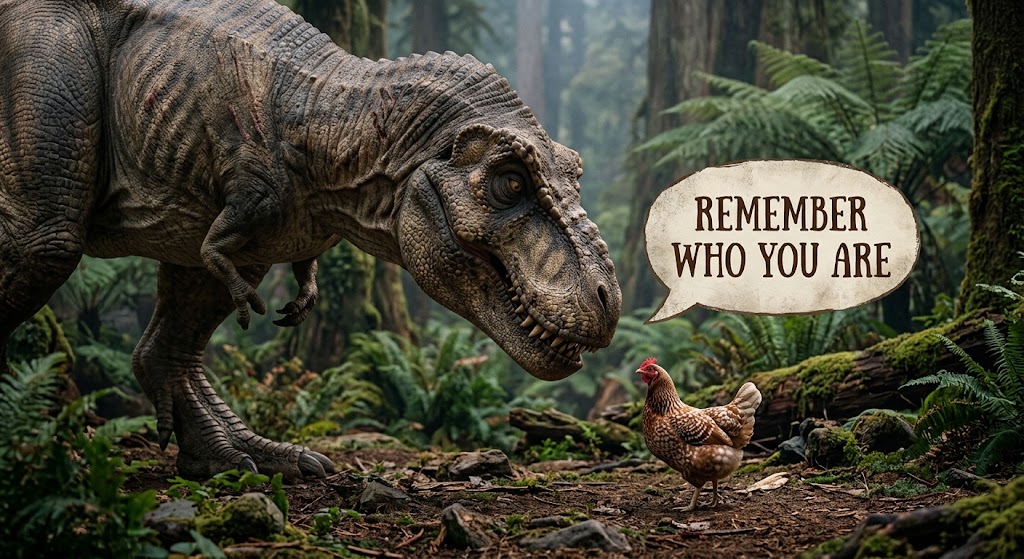
Imagine looking at a chicken walking peacefully across a farmyard. It scratches the ground, searches for food, flaps its wings, and makes its familiar sounds. Nothing particularly extraordinary, right?
But what if we told you that you are looking at a living relative of one of the most fascinating groups of predators that ever walked the Earth?
Birds are not simply descendants of dinosaurs. Scientifically, they are dinosaurs.
From the Age of Giants to the Modern World
Millions of years ago, the Earth was dominated by dinosaurs. Among them were the theropods, a group of mostly bipedal dinosaurs that included some of the most famous predators in history.
One of the best-known members was Tyrannosaurus rex, a powerful predator with enormous jaws, sharp teeth, and tiny arms.
But not all theropods were enormous monsters. Some were small, lightweight, feathered animals. Over millions of years, certain branches of these dinosaurs evolved into the birds we know today.
The evolutionary connection between dinosaurs and modern birds is supported by an extraordinary fossil record. Scientists have discovered feathered dinosaurs, fossils showing bird-like skeletons, and many anatomical similarities between ancient theropods and modern birds.
The Chicken: A Living Dinosaur
Look closely at a chicken.
Its legs, feet, skeletal structure, and many aspects of its anatomy reveal its evolutionary heritage. Birds share numerous characteristics with theropod dinosaurs, including a specialized wrist structure, three main toes, hollow bones in many species, and feathers.
Even the famous T. rex belongs to the same broad evolutionary group as modern birds.
Of course, a chicken is not a miniature Tyrannosaurus rex. Millions of years of evolution separate modern birds from their ancient relatives. But their evolutionary history is connected.
And that makes every chicken something rather extraordinary: a living representative of the dinosaur lineage.
Evolution Never Forgot Its Past
The dinosaurs did not completely disappear 66 million years ago.
A catastrophic asteroid impact contributed to the extinction of all non-avian dinosaurs, but one branch survived: the ancestors of modern birds.
From those survivors came an incredible diversity of life — eagles, penguins, owls, hummingbirds, ostriches, and even the humble chicken.
Today, birds live almost everywhere on Earth. They fly across oceans, hunt from the sky, swim through freezing waters, and occupy ecosystems across the planet.
The age of dinosaurs never truly ended. It transformed.
Remember Who You Are
The next time you see a chicken walking around, take a second look.
Behind those feathers, that beak, and those curious movements is an evolutionary story spanning hundreds of millions of years.
A creature that looks ordinary carries the legacy of an extraordinary world.
It is a reminder that evolution does not always erase the past. Sometimes, it transforms it into something completely unexpected.
You don't need to look like a dinosaur to carry its legacy.
Remember who you are. You are looking at a living dinosaur.